This is a short story I contributed on enterprenuership based on Chankaya’s sutras on leadership and governance as part of an anthology published by Ukiyoto publishing and released on 14th January 2024.
Saahas Zero Waste: An Enterprise in Waste Management
My article on Saahas Zero Waste , an organization dedicated to waste management based in the city of Bengaluru , published in Dec 2022 issue of TerraGreen ,a TERI Press publication.
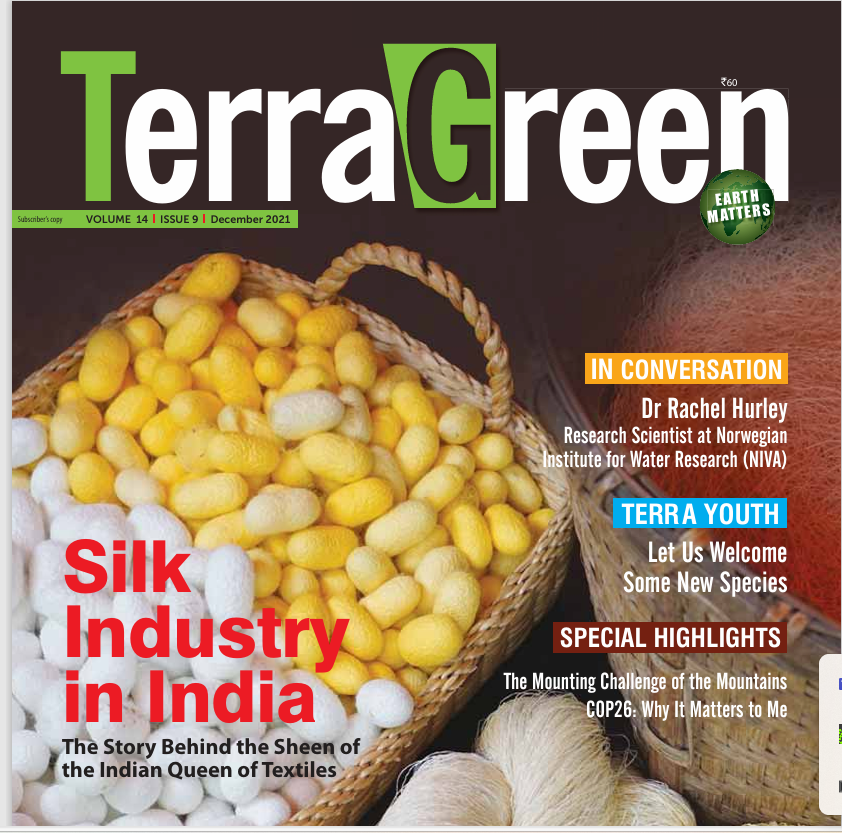
The story on silk production in India was published in TerraGreen magazine of TERI Press as a cover story in Dec 2021. The article can be viewed on the TERI website at this link
Silk Industry in India (The story behind the sheen of the queen of Indian textiles)
After becoming hugely popular in the west, Veganism has caught up in India and steadily growing by day. Thanks to the vegan movement and the entrepreneurs who are staunch believers in Veganism Vegan products have made big entry into the Indian consumer market. Vegan businesses now deal with non-leather, non-silk and every other product which was not derived from animals directly or indirectly.
Among
the vegan entrepreneurs that have set up shops in the Indian consumer space and
are slated to make impact are those dealing primarily with dairy products.
Driven by the response to vegan movement and discovering a huge market
potential for vegan dairy products, young entrepreneurs have ventured into
plant based dairy products in a big way. 22 year old Abhay Rangan is one such
entrepreneur from Bangalore city who along with his mother started out
Veganarke, a home- based venture to supply plant-based Milk, Curd, Butter to
their neighbours and friends and which has now turned into a start-up Goodmylk
with distribution centres in four major cities across India.
What is Veganism
Unlike
in the western countries where consumer’s diet largely comprises of meat and
other products from animals and sea creatures other than dairy products, a
majority Indian population since times immemorial has been dependent upon milk
for its nutritional needs of calcium, vitamins and proteins. Cow and cow’s milk
have been quintessential part of our culture. Who would hesitate a reverential
bow to the name Kamdhenu a perennial milk giver, or deny having heard stories
of Lord Krishna as a child stealing butter from clay-pots? Cow’s milk has been considered essential for
growing children, to strengthen their bones, and build their stamina for
future. Remember the movie Bhag Milka Bhag where the need for milk to
strengthen the ace -runner’s stamina was so well portrayed?
Here
is the crux of the matter- a question to ponder about. Why now the need to go
for plant- based milk and its derivatives to replace something that was so much
part of Indian Culture and dietary requirement.
Among
many reasons, apparently the primary reason is the scepticism about the quality
of bovine’s milk attributed to the growing awareness of the cruelty and
exploitation of milk yielding animals and the increasing number of activists
fighting to stop the cruelty. Milk industry related environmental concerns is also
a major factor for many to advocate alternative dairy products.
Bovine Milk production in
India
Since
independence in 1947, Indian milk production has grown from producing 17
million tons of milk in 1951 to producing 176.4 million tonnes in 2017- 18 recording
a growth of 6.65 %. India ranks first among the world’s milk producing nations
since 1998 and has the largest bovine population in the World. This transformation
is attributed to the advent of dairy cooperatives in the 70s also known as White
Revolution.
The
per capita availability of milk in the country which was 130 gram per day
during 1950-51 has increased to 374 gram per day in 2017-18 as against the
world estimated average consumption of 294 grams per day in that year.
Dairying – an important
source of rural income
For
millions of rural families, dairying has provided employment and income
generating opportunities particularly for marginal, landless labours and women
farmers. For more than one-fifth of agricultural households with very small
parcels of land (less than 0.01 hectare) and an average farm size of between
1-3 cows per farm, the milk production is on an average about 1,000
Kg/cow/year.
Of
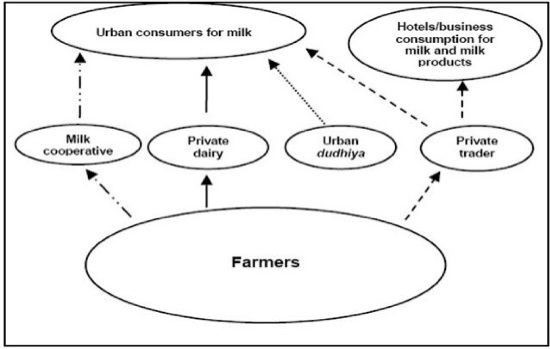
the total milk production in the country, about 48% milk is either consumed at
the producer level or sold to non-producers in the rural area. The balance 52 %
of the milk is marketable surplus available for sale to consumers in urban
areas, 40% of which is estimated as handled by the organized sector (i.e. 20%
each by C-operative & Private Dairies) and the remaining 60 % by the
unorganized sector.
Up
to March 2018, National Dairy Development, government of India brought about 16.6
million farmers under the ambit of about 1,85,903 village level Dairy Cooperative
Societies (DCS), with procurement of daily average of milk about 475.6 Lakh Kg
per day (LKgPD) during 2017-18 and the sale of the liquid milk to 349.6 Lakh Liter per day (LLPD).
The
milk industry has thus proved an important driver of rural economy, economically
empowering women farmers and encouraging them to assume leadership roles through
the cooperatives. Transformation of the country to self-sufficiency and
sustained growth in the availability of milk and milk products and its
nutritional values to the growing population has been due to concerted efforts of
government and the private sector with encouragement for use of high yielding
cross breeds and optimal use of technology for processing of milk products.
Low
pricing: Despite being the one of the largest milk- producing
countries in the world, however, India accounts for a negligible share in the
worldwide dairy trade. Since the pricing of milk is based on the fat content,
buffalo milk offers higher profit margins as compared to cow milk as it
contains higher fat.
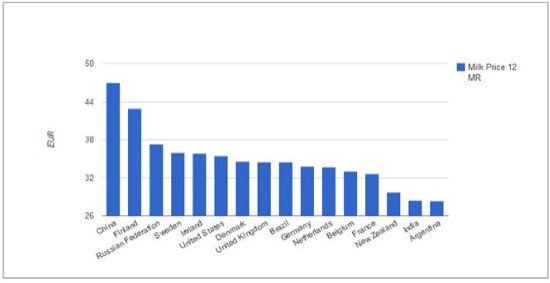
NUMBER 3: GLOBAL MILK PRICE (FARM
GATE) NOVEMBER 2013 – IN EURO
Source: DeLaval India
(Milkproduction.Com/Library/Editorial-articles/Milk quality in India
Driven
by the desire for better returns and due to lack of proper education and
training and despite government measures in place, unfortunately, a section of cow
farmers have been resorting to unethical practices for higher milk yields. Indiscriminate
injection of Oxytocin in the bovine’s blood to enhance its milk yield,
antibiotics injections as treatment for Metastasis a common problem in cow
udders due to poor sanitary conditions of the cow sheds, and the fear and
scepticism about these undesirable chemicals getting into consumers’ blood
through the cow’s milk stream are the major reason for the activists to raise
voice against it. Besides, every male calf of cross breed, after being born and
considered worthless, ending up in a slaughterhouse are the reasons for their
revolt.
Poor
maintenance of records:
A recent Livestock census reveals that records of some 88 million
In-Milk animals showing important information of those in breeding stage, their
productivity, treatment and vaccination are unavailable on an annual basis
attributed to lack of system for recording, with no proper animal
identification and traceability with their sanitary and phyto- sanitary
conditions.
Environmental
challenges: Deforestation; soil erosion; overgrazing;
desertification; air pollution from industrial effluents and vehicle emissions;
water pollution from raw sewage and runoff of agricultural pesticides; the tap
water not being potable throughout the country and the ever-growing population
is overstraining natural resources.
***
Notwithstanding
the challenges, the changing lifestyles due to rapid urbanization accompanied
by changing milk consumption pattern are putting further pressure on the need
for milk and milk- based value-added products. Hence, the need of providing
ample feed to the bovine in the past too has shifted, in recent years, to
providing optimal nutrients to promote reproductive health matching to genetic
profile of the bovine.
Action
Plan: It is heartening that the recent national
dairy development policy has encompassed vast areas of action, under which the
focus is on increasing the number of few select indigenous breeds of the 43
indigenous cattle breeds and 13 Buffalo breeds which are known to be of better
adaptability, disease-resistance and feed efficiency ratio. By enhancing the average
productivity of milk of select breeds like Gir, with use of cutting- edge
technologies as below it is hoped to bring long- term sustainable solutions.
Making easy availability of exotic germplasms for high-yielding cross breed, along with its identification and traceability, connecting breeders, State agencies and stake holders, through the e-market portal “E- PashuHaat”.
Setting up of Artificial insemination centres at different levels of rural areas and help with tools and techniques made easily available to farmers.
Development and standardization of technologies like sexing of semen, for indigenous breeds like Sahiwal, Hariana, Red Sindhi, Rathi and Gir to produce greater number of high genetic merit females keeping in mind profitability of dairy farming.
1.What was the inspiration to start Goodmylk?
I was a born vegetarian, became a vegan at 13. My parents
and sister are vegans. I was an activist and as a teenager I was fighting
against cruelty towards animals along with society for animal protection.
2. How does veganism help environment?
To give one litre of cow milk, about 1200 litres of water
is used, forests are denuded to make way for grazing land and providing fodder.
By way of veganism we are using much less resources. That said there can be no
business where you don’t leave carbon footprint.
3. what is your view about latest practices in dairy
industry? Isn’t the new breed of dairy entrepreneurs taking care of cows and
its exploitation?
Extracting milk in any form or method from cows is like
going against nature and harming a living being. It is against our values and I
have subscribed to the value of ahimsa(non-violence).
4. Do you think plant based vegan milk can be a
hundred percent substitute to cow’s milk in terms of its nutritional value? How
do you ensure quality of raw materials for Goodmylk?
Our Plant based Goodmylk is highly nutritious with all
important proteins required for sustenance and growth. There are many
supplements available or other foods for any missing nutrition. I wish I could
vet every batch of raw materials, but I do ensure control over the quality of
the ingredients.
5. Please tell about your journey as an entrepreneur?
Doing business and setting up a successful business is
never easy. I had my ups and downs in the field where there are already many
players. The main challenge was to navigate the entire spectrum of technology,
vendor management, warehouse management, logistics, getting cool investors who
believed in me and my vision. It was how I retrofitted my vision into the vegan
space by finding the right market with the right products and the right
partners who already had the manufacturing know how.
6. Any
expansion plans? Where do you see yourself in the next 2-3 years?
I want to expand the distribution of Goodmylk as widely
as possible and sell Goodmylk dairy products in every part of India. It should
be seen and sold from every shop, from every shelf, from where the dairy milk
is being sold. If I’m making our world little more loving and human, I’m happy.
Interview with Abhay Rangan
Acknowledgements
1. Inputs from Dr. JS Ashwath kumar, Chief Veterinary
officer, Department of Animal husbandry and Veterinary Sciences, Government of
Karnataka
2. National Action Plan for Dairy Development-vision2022,
Ministry of Agriculture and Farmers welfare, Government of India, January 2018

 Welcome to Lata's Site