Author Archives: latavishwanath

Unknown's avatar

About latavishwanath

Singapore based writer

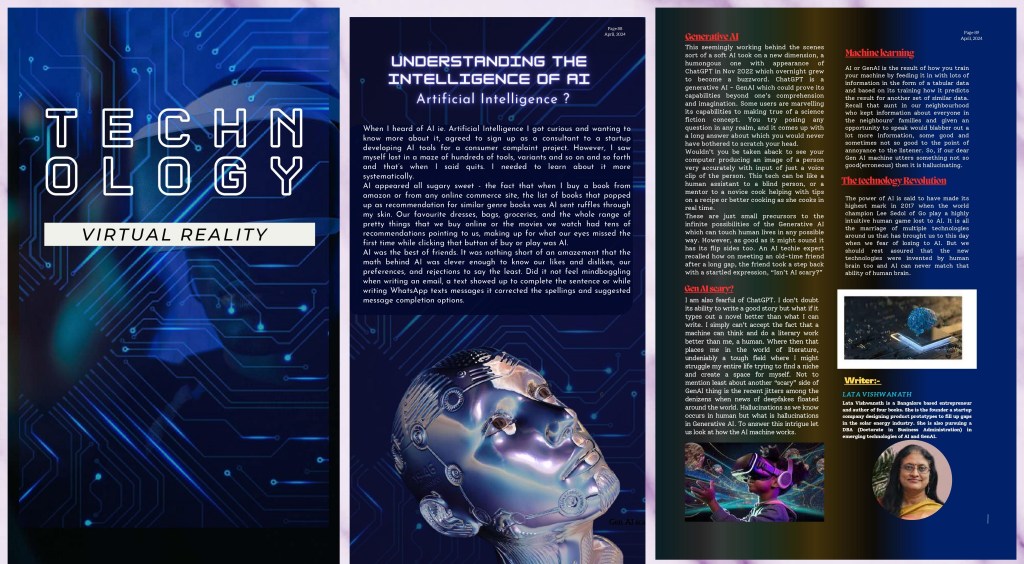
This is my first ever article on AI published in the second quarterly edition of global e-zine Reader’s choice magazine.Thanks to its editor Kainaz Juzzawalla for inviting and accepting the submission.https://heyzine.com/flip-book/e2f3464286.html

When I heard of AI ie. Artificial Intelligence I got curious and wanting to know more about it, agreed to sign up as a consultant to a startup developing AI tools for a consumer complaint project. However, I saw myself lost in a maze of hundreds of tools, variants and so on and so forth and that’s when I said quits. I needed to learn about it more systematically.

AI appeared all sugary sweet – the fact that when I buy a book from amazon or from any online commerce site, the list of books that popped up as recommendation for similar genre books was AI sent ruffles through my skin. Our favourite dresses, bags, groceries, and the whole range of pretty things that we buy online or the movies we watch had tens of recommendations pointing to us, making up for what our eyes missed the first time while clicking that button of buy or play was AI.

AI was the best of friends. It was nothing short of an amazement that the math behind AI was clever enough to know our likes and dislikes, our preferences, and rejections to say the least. Did it not feel mindboggling when writing an email, a text showed up to complete the sentence or while writing WhatsApp texts messages it corrected the spellings and suggested message completion options.

Generative AI

Wouldn’t you be taken aback to see your computer producing an image of a person very accurately with input of just a voice clip of the person. This tech can be like a human assistant to a blind person, or a mentor to a novice cook helping with tips on a recipe or better cooking as she cooks in real time.

These are just small precursors to the infinite possibilities of the Generative AI which can touch human lives in any possible way. However, as good as it might sound it has its flip sides too. An AI techie expert recalled how on meeting an old-time friend after a long gap, the friend took a step back with a startled expression, “Isn’t AI scary?”

Gen AI scary?

I am also fearful of ChatGPT. I don’t doubt its ability to write a good story but what if it types out a novel better than what I can write. I simply can’t accept the fact that a machine can think and do a literary work better than me, a human. Where then that places me in the world of literature, undeniably a tough field where I might struggle my entire life trying to find a niche and create a space for myself. Not to mention least about another “scary” side of GenAI thing is the recent jitters among the denizens when news of deepfakes floated around the world. Hallucinations as we know occurs in human but what is hallucinations in Generative AI. To answer this intrigue let us look at how the AI machine works.

machine learning

AI or GenAI is the result of how you train your machine by feeding it in with lots of information in the form of a tabular data and based on its training how it predicts the result for another set of similar data. Recall that aunt in our neighbourhood who kept information about everyone in the neighbours’ families and given an opportunity to speak would blabber out a lot more information, some good and sometimes not so good to the point of annoyance to the listener. So, if our dear Gen AI machine utters something not so good(erroneous) then it is hallucinating.

The technology Revolution

The power of AI is said to have made its highest mark in 2017 when the world champion Lee Sedol of Go play a highly intuitive human game lost to AI. It is all the marriage of multiple technologies around us that has brought us to this day when we fear of losing to AI. But we should rest assured that the new technologies were invented by human brain too and AI can never match that ability of human brain.

Is the year ending a new beginning ?

Yet another year comes to an end and it is inevitably a human nature to look back on the year gone by- on whether we met the target we set for ourselves over the year, what we would consider an achievement, what we fell short in,and so on and so forth. It is especially so for people in the writing profession.

It is hard to meet the target we writers set for ourselves in the beginning of the year. In this creative profession where there is no one breathing on our necks to meet a deadline or scrutinizing each step , it is wholly dependent on us how we meet the writing targets we set for ourselves, whether by the number of hours spent on writing, research, improving vocabulary and sentence structures etc.

The achievements in writing, in my opinion, can also account for the books we read over the year, the articles or blogs we got published, the books that we were able to finish writing and made efforts towards getting published. But generally it is easier said than done. The fact that I am returning to my blog after many months shows that freelance writing is not a time bound activity. However, coming to the last day of the year, there is a pressure to assess the same before the clock for the new year sets in .

I would consider a few targets I set for myself that I could not meet. For ex. the novel I began in 2020 is yet to make a progress. The Sc-fi story I conceptualized in the beginning of the year has not seen light of the day. However, the fact that my book of quotes and poetry Dulcet of Pink Petals was published is my biggest achievement of the year. I have attached the book cover pic at the top. I would consider my article on Green Hydrogen as another achievement towards writing on environment and sustainability. The awards winning best sellers- The monk who sold his ferrari, The english patient, When we were orphans , Rumi’s poetry, the Psychology of money a recent best seller , A thousand stitches are the books I am proud of having read.

There are activities like travelling whose creative side can certainly help blossom a person into a better writer. Among other achievements which I would consider as the biggest of the year and I am proud of is my progress towards entreprenuership-my startup Surya tech and the progress it made in a short span of three months.

The year ends and a new cycle begins. If our new resolutions include carrying on the unfinished projects with the same gusto as the previous year , there is no ending or beginning , rather it is a continuum.

Late posting: My article on Tagore was published in the classic compendium 2022 brought by Literoma as part of Tagore litfest held in Kolkata in May 2022

Rabindranath Tagore’s idea of one Asia

Tagore romanticized the idea of one united Asia. His paeans on bridging the gap of China and India and bring the two countries closer were well known. He was venerated by people across the Asian countries as the greatest living poet and intellectual. He was an ardent traveler and did not miss an opportunity to travel to Asian countries. It was his eagerness to see the Indianness, the cultural influence of India in all those countries where Hinduism was part of their culture and tradition that took him to the countries in Southeast Asia. Indonesia, Malaysia, Thailand, Japan, Burma where he travelled, he interacted with much enthusiasm and wrote poems with love for the countries after every visit.

Guru Rabindranath Tagore’s charisma was so great and so deeply rooted in Southeast Asia that his 100th birth anniversary was observed in Singapore in 1961 and several discussions and forums were held in his honour. The Institute of Southeast Asian Research in Singapore has a dedicated Nalanda Sriwijaya center established with the aim of research study of Chinese and Indian diasporas, their interactions, maritime and trade links with Southeast Asia, maritime technologies, historical spread of Buddhist, Hindu, Islamic, and Christian networks across Asia, learning and cultural exchanges among Asian societies, cross cultural interactions between  India and China, during the Late Qing and Republican Periods. Among the focus of studies, it is heartening that the center has marked the study on influence of Rabindranath Tagore and his contemporaries across Asia as one of the main research projects.  The center is also working with the West Bengal State Archives to identify and digitize materials relevant to Southeast Asia and China-India relations.

Perceptions of Asia by Rabindranath Tagore

The Nalanda Sriwijaya center explores the conversations across Asia conducted by Rabindranath Tagore, and his contemporaries who all imagined Asia as an abstract entity, transcending the colonial boundaries.

In 2011, as part of 150th year of Rabindranath’s Tagore’s birth anniversary, lectures and events were held across four countries in places of academic excellence, Harvard University US, Beijing University in China, Singapore ISEAS and Netaji Research Bureau in Kolkata. A series of four conferences examined Tagore’s travels in Asia and the wider impact of his ideas on Asia, to understand the Tagore phenomena through his experiences in Japan and China during the 1910s and 1920s.  A Different Universalism lecture series explored the political, intellectual, cultural conversations conducted by Tagore and his contemporaries towards a global vision in the age of colonial empire and anti-colonial nationalism. It also examined the modern intellectual history of Asia as well as theories of universalism, cosmopolitanism, and internationalism.

Rabindranath Tagore’s Influential Travels

Rabindranath Tagore (7 May 1861 – 7 August 1941), was the first non-European to win the Nobel Prize for Literature and an icon of intra-Asian interactions and of the Pan-Asian movement. Tagore made his first trip beyond India in 1878 to Britain to study and several influential voyages to Asian countries after receiving the Nobel Prize in 1913.

Beginning in 1916 he visited Burma and in 1922 he travelled to Sri Lanka. Longer visits to China and Japan took place in 1924, Singapore, Malaya, Indonesia, and Thailand in 1927, and China, Japan, and Indochina in 1929, were interspersed with further visits to Sri Lanka and, to many countries in the Middle East and Europe. The ways in which Tagore was received and reacted to during his Asian voyages varied enormously, with some in his audiences considering him a “seer and patriarch”, or even a saint with “a great and tender soul”, while others were vehement in their denunciation of their visitor, who claimed to be intent on saving the spirituality of the East from the materialism of the West.

China Visit in 1924

Tagore was a celebrated figure even before his arrival in China in April 1924. Chen Duxiu, one of the founding fathers of the Communist Party of China had translated Tagore’s prize-winning anthology, Gitanjali in 1915. Guo Moruo, a writer of Tagore’s status was deeply influenced by Tagore when he was studying in Japan from 1914 to 1920.

On receiving an invitation, Tagore was overjoyed, “it was an invitation to India herself and as her humble son I would accept, and though India being poor in many respects had something to give to the world’. On arrival he was the only invitee of Emperor to the inner sanctum of the Forbidden City, after the British Sir Reginald Johnston. He interacted with many Chinese poets with a hope that a dreamer among them will preach the message of love and bridge the chasms of passions widening since ages. Famous Chinese poet Xu Zhimo, also Tagore’s close friend on being asked to be an interpreter, in his joy likened it to transcribing nightingales’ passionate songs or Niagara’s grand roars.

Tagore was deeply touched when a renowned Chinese scholar, Liang Qichao, presented him the Chinese name, ‘Zhu Zhendan’ translating as “thunder of the oriental dawn” as also when his play Chitra was performed by young Chinese actors. He truly believed in the mutually beneficial interactive relationship and passionately advocated the reopening of the path between the two countries that got obscured through the centuries. Barring some young students, his message of love and brotherhood were well received and admired by Chinese intellectuals as espousal of civilizational strength of the east.

His international university, ‘Visva-Bharati’, played a pioneering role in development of Chinese studies in India. The establishment of the first Sino-Indian Cultural Society, and then, ‘Cheena Bhavana’ (Chinese Department) at Shantiniketan were corner stones for this cause. Scholars, teachers like Tan Yun-Shan, who led Cheena Bhavan for many years, contributed greatly to modern India’s understanding of Chinese civilization and her modern development. The late Ji Xianlin, Padma Bhushan and doyen of Indologists in China observed that Tagore was an icon of Sino-Indian friendship both in India and China.

Visits to Southeast Asian countries in 1927

Singapore

Day by day records of his visit in 1927 to Singapore starting 25th July show the respect for the great poet among elite of Singapore society. He was introduced as greatest living poet of East after he gave a speech on India and China and how Indian students should read Chinese history. Gurudev spoke about India’s glorious past, and that all his countrymen should support the ideals of Visva Bharati. He addressed school children and teachers, gave a lecture on China India cultural fellowship in Victoria theatre.

Malaysia

As he sailed to Malacca, he was given a rousing reception among Chinese and Indo Ceylonese and post his lecture on education, an amount of $3500 was raised for Visva Bharati. In Muar and Kuala Lumpur as next stoppages he was garlanded and given ‘at home’ honour with performances by Chinese, British and Ceylonese communities. His speeches were mainly about unity of human race and India China relations, uniting of China India cultures in service of the whole world. His reception was equally grand in Klang, Ipoh, Kuala Kangsar, Taiping, Telok Anson. In Penang he laid foundation stone of a building and addressed to a large gathering that Asia was the birth- place of many religions of the world. He spoke about nationalism and emphasized that India must understand history and culture of China. His public speech was the best of all according to his companion and teammate. His next destinations were Surabaya, Bali, and Yogyakarta in Indonesia.

Indonesia

Indonesian Hindu islands and cities had captured a place deep in Gurudev’s heart who was always enthused by cultural interactions rather than military conquests. The Sriwijaya empire of Indonesia had given its patronage to the Buddhist university at Nalanda and enjoyed friendly ties with the Pala kingdom of Bengal and both had suffered military defeat at the hands of the Cholas of south India in the 1020s. As Tagore sailed on Plancius from Singapore towards Batavia on August 16, he wrote his poem Sriwijaylakshmi celebrating the renewal of bond after a thousand-year separation, which was given an equally classical response by a leading Javanese poet addressing him as an elder brother to guide in the world, teach scriptures, tongue and all that is needed to exist.

An interim pilgrimage to Bali and an interaction with the king of Karengasem left Tagore completely stunned. The king uttered the word Samudra and other synonyms for ocean such as Sagara, Abdhi, Jaladhya and did Sanskrit recitation of seven seas, mountains, skies, and forests. Mention of names of Indian mountains and rivers astonished him further and he observed that in our history Bharatvarsha (India) had realized its geographical unity in a special way. The discovery of further variations in the Southeast Asian versions of the great epics Ramayana and Mahabharata enabled Tagore through comparative study to propound the version as original and an interpretation of marriage (Ram and Sita) as a metaphor.

However, he noted that the ‘Hindu’ ethos of the island was no bar to Arab Muslims, Gujarati Khoja Muslims and Chinese merchants conducting trade. After his departure from the island Rabindranath Tagore wrote one of his most beautiful poems, Bali which was later renamed Sagarika (Sea Maiden) of which the opening verse read: Having bathed in the sea with your wet tresses you sat on the rocky beach. Your loose yellow robe drew a forbidding line around you on the earth…

From Bali, Tagore travelled to Surabaya, a predominantly Muslim Island of Java. His romanticization of India and witnessing the stories of Ramayana and Mahabharata suffusing the dance and drama of the Muslim Javanese, made him call it “Vyas Indies’ instead of Dutch indies.  The poet inaugurated a new road in Suryakarta, called Tagaro Straat. The temple ruins at Prambanan reminded him of Bhubaneswar in Orissa. He wrote about the great Saiva-Buddhist temple complex of Borobodur in his poem Borobodur. Tagore pursued the Buddhist connection in Siam and composed some of very popular songs on his way back through Southeast Asia. In Bangkok, Tagore met the prince of Chantabun. His poem Siam composed on October 11, 1927, gave a final expression to Tagore’s search for a greater India: Today I will bear witness to India’s glory that transcended its own boundaries I will pay it homage outside India at your door.

Tagore’s obvious pride in ‘India’s entry into the universal’, were based on his partial view of the historical relations between the two regions, India as not a monolith to discuss how cultural influences radiated out, cultural influences happened through active historical agents.

Travel to Middle East in 1932

After seeing European colonized Muslim societies of Malaya and Java, he boarded a Dutch airplane to travel to Muslim sovereign countries of Iran and Iraq in April 1932. In Iran he was poet of the east and wrote an essay Parashye (In Persia) which is much more than a diary or a travelogue. He had a special affinity to Persian Sufi poets. Tagore wrote, ‘my identity has another special feature. I am Indo-Aryan…I have a blood relationship with them.’ There was absolutely no occasion, Tagore asserted, when the Persians made him feel that they belonged to another society or religious community.

At a reception in a carpeted garden surrounding Saadi’s grave Tagore claimed kinship with the Sufi poets and composers of yesteryears; it was just that he used the language of the modern age. He had been agonizing about the blindness and prejudice that went by the name of religion and wanted India to be free of this terrible affliction. “Will the tavern’s door be flung open,” Tagore read when he opened his eyes, ‘and with it the tangled knots of life unfasten?

Tagore was entranced by the gardens and mosques of Isfahan. He visited the Masjide-Shah started by Shah Abbas and the neighboring Masjid-e-Chahar-e-bagh. Not surprisingly, Tagore compared Shah Abbas with India’s Akbar. During his two weeks in Tehran, he participated in as many as eighteen public functions. Persian music continued to intrigue him with its elements of sameness and difference in relation to north Indian classical music. On the violin the melodies sounded like the morning ragas Bhairon, Ramkeli and even the pure Bhairavi.

The poet’s 71st birthday on May 6, 1932, was celebrated with great fanfare in Tehran. In return for all the bouquets, Tagore gave a gift in the form of a poem titled ‘Iran’ which ended with a verse of victory to Iran. In return he received from parliamentary leaders an exquisitely produced volume of the poetry of Anwari. Among the various sights that the poet saw were Darius’s carvings on the mountainside in Behistun and the glorious sculpture of the Sassanid age in Takibustan.

On seeing the ferocity of British air force on Iraqi villagers he reflected on the shift from sea power to air power in human history and easiness of killing desert dwellers from the air and wrote as a message: From the beginning of our days man has imagined the seat of divinity in the upper air from which comes light and blows the breath of life for all creatures on this earth. The peace of its dawn, the splendor of its sunset, the voice of eternity in its starry silence have inspired countless generations of men with an ineffable presence of the infinite urging their minds away from the sordid interests of daily life…   Reflecting on how different his life nurtured by the rivers of Bengal was from the struggle for existence in the desert, bedouin chief surprised him. “Our Prophet has taught us,’ the chief said, ‘that he is a true Muslim from whom no fellow human being fears any harm.

In late May 1932 the intellectuals of Baghdad organized a civic reception in Tagore’s honour. Tagore expressed his anguish about Hindu-Muslim conflict in India and invited his hosts to resend their Prophet’s message of Universal brotherhood across the Arabian Sea so that India could be saved from communitarian narrow-mindedness, inhuman intolerance and the degradation of liberal religion and put on the high road to unity and freedom.

The aspirational quality of a different universalism was perhaps best expressed by Tagore in a poem-painting signed. The night has ended. Put out the light of the lamp of thine own narrow corner smudged with smoke. The great morning which is for all appears in the East. Let its light reveal us to each other who walk on the same path of pilgrimage.

In the present day of war and conflict, it is relevant to throw light on Tagore’s pan Asian ideals. He undoubtedly was a powerful critic of worshipping the Nation as God and he simply did not want Indian patriots to imitate European nationalists. Yet he loved the land that had nurtured him. It is not without reason that Mahatma Gandhi in his obituary comment on Rabindranath Tagore in 1941 lauded the poet as ‘an ardent nationalist’. Indeed, a nationalist with a unique cosmopolitanism and a different universalism best describes Rabindranath Tagore.           

***

Source: Nalanda Sriwijaya Center’s Tagore Booklet

 Lata Vishwanath

I have attempted a poetry review first time as a writer. I don’t claim to be a poet, never thought it was my forte and find quite a lot of poetry difficult to grasp. Still I did try some ocassional scribblings in the last two years.These short verses, though may not be of exemplary poetic value, perhaps were inevitable emotions coming out from my deep within durign the pandemic. That is how poets are born I guess. I am now more regular in reading poems and trying to decipher their meaning between lines.

poetry review

I chose to do a review of poetry collection by Anirban Bhattacharya because of two reasons. I got introduced to him when I pitched my manuscript to Penmancy’s pitchfest in April-May 2021. After I got to know that he is the producer of my favourite crime TV show Crime Patrol on Sony TV , who was going to interview me as one of the judges I was awestruck and thrilled and considered myself fortunate. His non-fiction India’s deadly dozens is best seller on amazon. My fascination and curiosity about his work made me pick up his newly released poetry book and try this review.

The poetry collection of Mumblings and Musings by Anirban Bhattacharya is awe inspiring and deeply touching. Going from page to page each poem reveals life in such varied shades and colours filtered through lenses of diverse men and women that hit your heart with razor sharpness as much they leave you stunned with open jaws. Certainly the poet has fascination for death as much as for life. Going from page after page, he makes the reader feel, touch and smell death and darkness very closely. Though not a surprise coming from the author of the best seller The Deadly Dozens, and producer of Crime Patrol and Saavdhan India,  he clearly is a talented writer wearing many hats.

His tone of melancholy and morbidity run through all his poems that is intricately woven with his empathy towards the poor and underprivileged. I was particularly besotted with the lines

concrete hands search skies
bound by asbestos souls
Voices rebound off broken walls…, in the snippets of conversations.
 

The world seen
Through photo chromatic lenses
Watching green grass
Sitting on knees…, in the world now


Fingerless palms greet you
A beatific smile
All is well with the world
The tethered throne is a piece of land that she calls her own.. in The Tenth leper

My other favourites are Clothesline, The fly, Feelings, Final Chant , Merging, The Butcher, The Madman on the street. His memories – often harking to past make one in many of the brilliant literary tools he uses to depict life’s ephemerality, pain and poignancy. The same prevail in some of the tales from his musings and monologues  which though seem like his personal experiences the themes are compelling and resonate with every reader. The accompanying photographs give a visual complement to every poem with the incisive depth of its emotions.
Reading the collection I got the notion of wasteland and other poems by the famous master poet of all times, TS Eliot. Certainly Anirban is a master in his own right. 

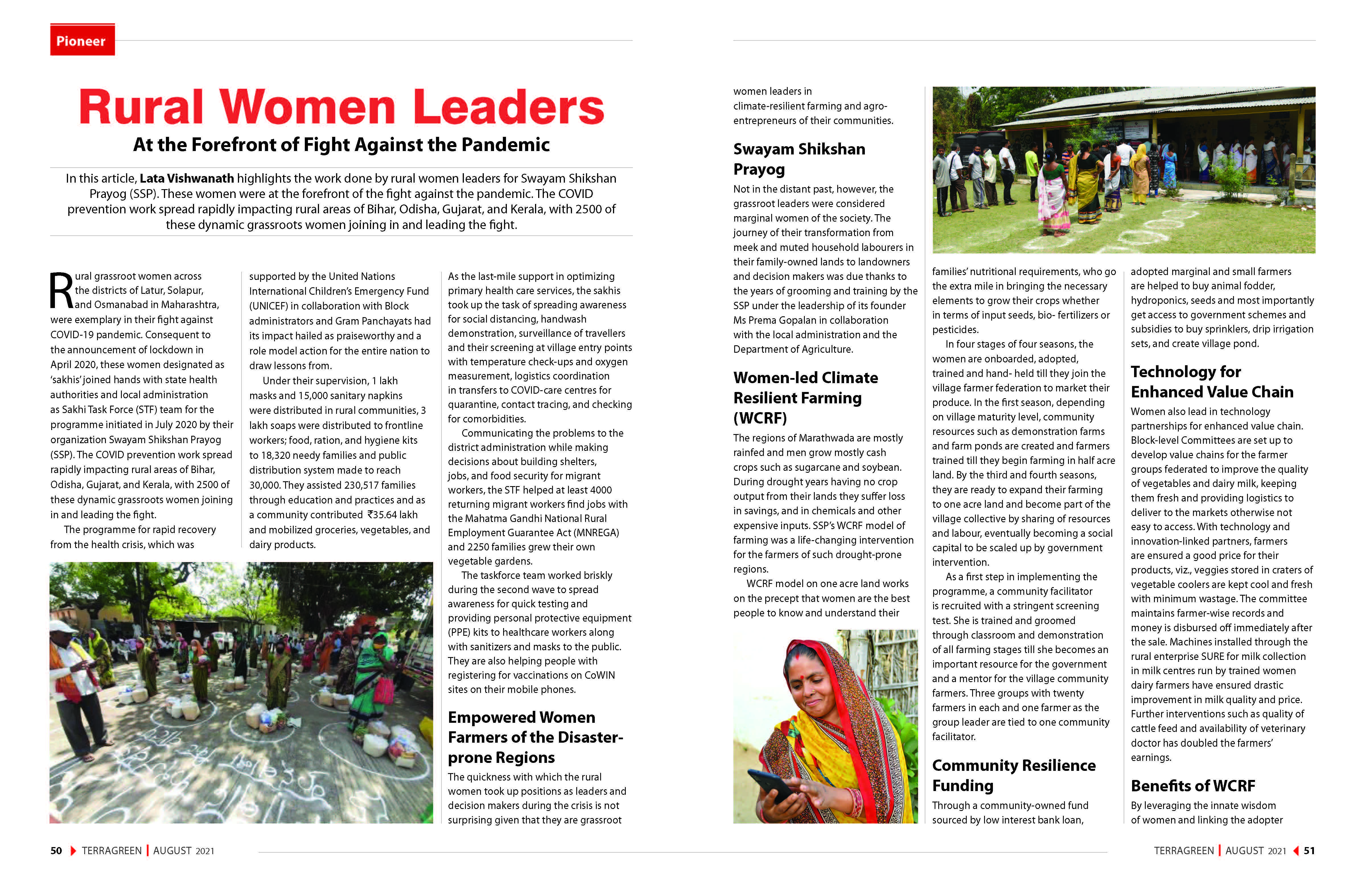
My first article this year published in TerraGreen magazine after my return to India. I am glad to have written about the amazing rural women leaders who are the forefront of fight against the pandemic.

Rural Women leaders at the forefront of fight against the Pandemic

Rural grassroot women across the districts of Latur, Solapur, Osmanabad in Maharashtra, were exemplary in their fight against Covid pandemic Consequent to the announcement of lockdown in Aril 2020, these women designated as Sakhis joined hands with state health authorities and local administration as Sakhi Task Force team for the program initiated in July 2020 by their organisation Swayam Shikshan Prayog (SSP). The covid prevention work spread rapidly impacting rural areas of Bihar, Odisha, Gujarat, and Kerala, with 2500 of these dynamic grassroots women joining in and leading the fight.

The program for rapid recovery from the health crisis which was supported by UNICEF in collaboration with Block administrators and Gram Panchayats had its impact hailed as praiseworthy and a role model action for the entire nation to draw lessons from.

Under their supervision 1 lakh masks and 15,000 sanitary napkins were distributed in rural communities, 3 lakh soaps were distributed to frontline workers; food, ration, and hygiene kits to 18,320 needy families and PDS made to reach 30,000. They assisted 2,30,517 families through education and practices and as a community contributed Rs. 35.64 lakhs and mobilized groceries, vegetables & dairy products.

As the last mile support in optimizing Primary health care services, the Sakhis took up the task of spreading awareness for social distancing, handwash demonstration, surveillance of travellers and their screening at village entry points with temperature check-ups and oxygen measurement, logistics coordination in transfers to covid care centres for quarantine, contact tracing and checking for comorbidities.

Communicating the problems to the district administration while making decisions about building shelters, jobs, and food security for migrant workers, the STF helped at least 4000 returning migrant workers find jobs with MNREGA and 2,250 families grew their own vegetable gardens.

The taskforce team worked briskly during the second wave to spread awareness for quick testing and providing PPE kits to health care workers along with sanitizers and masks to the public. They are also helping people with registering for vaccinations on COWIN sites on their mobile phones. 

Empowered women farmers of the disaster- prone regions

The quickness with which the rural women took up positions as leaders and decision makers during the crisis is not surprising given that they are grassroot women leaders in climate resilient farming and agro-entrepreneurs of their communities.

Swayam Shikshan Prayog

Not in the distant past, however, the grassroot leaders were considered marginal women of the society. The journey of their transformation from meek and muted household labourers in their family owned- lands to landowners and decision makers was due thanks to the years of grooming and training by the Swayam Shiksan Prayog under the leadership of its founder Ms. Prema Gopalan in collaboration with the local administration and the Department of Agriculture.

Women led Climate Resilient farming (WCRF)

The regions of Marathwada are mostly rain fed and men grow mostly cash crop like sugarcane and soyabean. During drought years having no crop output from their lands they suffer loss in savings, and in chemicals and other expensive inputs. SSP’s WCRF model of farming was a life changing intervention for the farmers of such drought prone regions.

WCRF model on one acre land works on the precept that women are the best people to know and understand their families’ nutritional requirements, who go the extra mile in bringing the necessary elements to grow their crops whether in terms of input seeds, bio fertilizers or pesticides.

In four stages of four seasons, the women are onboarded, adopted, trained and hand- held till they join the village farmer federation to market their produce. In the first season, depending on village maturity level, community resources like demonstration farms and farm ponds are created and farmers trained till they begin farming in half acre land. By the third and fourth seasons they are ready to expand their farming to one acre land and become part of the village collective by sharing of resources and labour, eventually becoming a social capital to be scaled up by Government intervention.

As a first step in implementing the program, a community facilitator is recruited with a stringent screening test. She is trained and groomed through classroom and demonstration of all farming stages till she becomes an important resource for the Government and a mentor for the village community farmers. Three groups with twenty farmers in each and one farmer as the group leader, are tied to one community facilitator.

Community resilience funding

Through a community owned fund sourced by low interest bank loan, adopted marginal and small farmers are helped to buy animal fodder, hydroponics, seeds and most importantly get access to government schemes and subsidies to buy sprinklers, drip irrigation sets, and create village pond.

Technology for Enhanced value chain

Women also lead in technology partnerships for enhanced value chain. Block level Committees are set up to develop value chains for the farmer groups federated to improve the quality of vegetables and dairy milk, keeping them fresh and providing logistics to deliver to the markets otherwise not easy to access. With technology and innovation linked partners, farmers are ensured a good price for their products viz. veggies stored in craters of vegetable coolers are kept cool and fresh with minimum wastage. The committee maintains farmer wise records and money is disbursed off immediately after the sale. Machines installed through the rural enterprise SURE for milk collection in milk centres run by trained women dairy farmers have ensured drastic improvement in milk quality and price. Further intervention like quality of cattle feed and availability of veterinary doctor has doubled the farmers’ earnings.

Benefits of WCRF

By leveraging the innate wisdom of women and linking the adopter farmers to government schemes the model has achieved food security, water security, livelihood security, and women empowerment. Farmers own water related assets while growing less water intensive crops with increase in crop productivity and less input costs. Convincing their husbands for transferring of the land rights is crucial to the women’s success and impressed husbands follow them in doing chemical free farming. Growing as many as 17 types of diverse crops results in good health and nutrition for their families with improved immunity for cough and cold problems, while the produce ensures savings on market bought food and enhanced agri-businesses.

Making the farming model effective and impacting has proved win- win for both SSP and its key eco-system partners who otherwise find it hard to reach out to the women farmers. The key partners are Government Agriculture department for water conservation and harvesting, ATMA for bio inputs for chemical less farming, the training partner Krishi Vigyan Kendra, and partners for market linkages, knowledge, and strategies.

SSP’s programs which has its outreach across five states provide the much-needed anchor to the government’s investments and schemes towards attracting more women into mainstream agriculture and climate resilient farming.

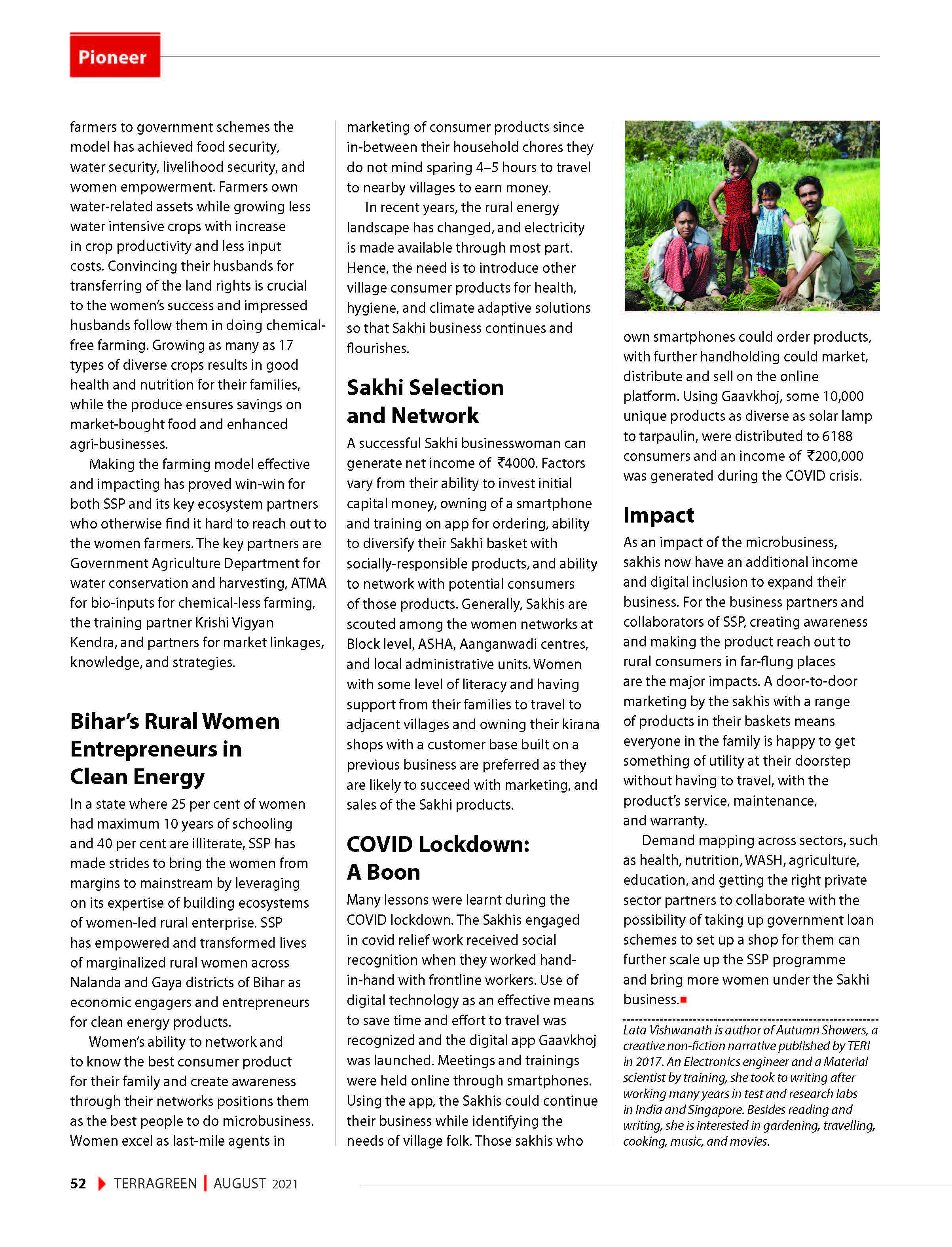
Bihar’s Rural women Entrepreneurs in clean energy

In a state where 25% of women had maximum 10 years of schooling and 40% are illiterate, SSP has made strides to bring the women from margins to mainstream by leveraging on its expertise of building ecosystems of women led rural enterprise. SSP has empowered and transformed lives of marginalized rural women across Nalanda and Gaya districts of Bihar as economic engagers and entrepreneurs for clean energy products.

Women’s ability to network and to know the best consumer product for their family and create awareness through their networks positions them as the best people to do microbusiness. Women excel as last mile agents in marketing of consumer products since in-between their household chores they do not mind sparing 4-5 hours to travel to nearby villages to earn money.

In recent years, the rural energy landscape has changed, and electricity is made available through most part. Hence the need is to introduce other village consumer products for health, hygiene, and climate adaptive solutions so that Sakhi business continues and flourishes.

Sakhi selection and network

A successful Sakhi businesswoman can generate net income of Rs. 4000/. Factors vary from their ability to invest initial capital money, owning of a smartphone and training on app for ordering, ability to diversify their Sakhi basket with socially responsible products and ability to network with potential consumers of those products. Generally, Sakhis are scouted among the women networks at Block level, ASHA, SHG networks, Aanganwadi centers, and local administrative units. Women with some level of literacy and having support from their families to travel to adjacent villages and owning their Kirana shops with a customer base built on a previous business are preferred as they are likely to succeed with marketing, and sales of the Sakhi products.

The Sakhis who can network, sell, and get more women Sakhis under them become Super Sakhis. 3 Super Sakhis are managed by one Block coordinator. The Super Sakhis extend hand holding to Sakhis to buy the products by credit, initially market, distribute and sell till they get confident of marketing their products.

Covid lockdown a Boon

Many lessons were learnt during covid lockdown. The Sakhis engaged in covid relief work received social recognition when they worked hand in hand with frontline workers. Use of digital technology as an effective means to save time and effort to travel was recognized and the digital app Gaavkhoj was launched. Meetings and trainings were held online through smartphone. Using the app, the Sakhis could continue their business while identifying the needs of village folk. Those Sakhis who own smartphones could order products, with further handholding could market, distribute and sell on the online platform. Using Gaavkhoj, some 10,000 unique products as diverse as solar lamp to tarpolain, were distributed to 6,188 consumers and an income of Rs.2,00000 generated during the Covid crisis.

Impact

As an impact of the microbusiness, Sakhis now have an additional income and digital inclusion to expand their business. For the business partners and collaborators of SSP, creating awareness and making the product reach out to rural consumers in far- flung places are the major impacts. A door-to-door marketing by the Sakhis with a range of products in their baskets means everyone in the family is happy to get something of utility at their doorstep without having to travel, with the product’s service, maintenance, and warranty.

Demand mapping across sectors like health, nutrition, WASH, agriculture, education, and getting the right private sector partners to collaborate with the possibility of taking up government loan schemes to set up a shop for them can further scale up the SSP program and bring more women under the Sakhi business.

***